
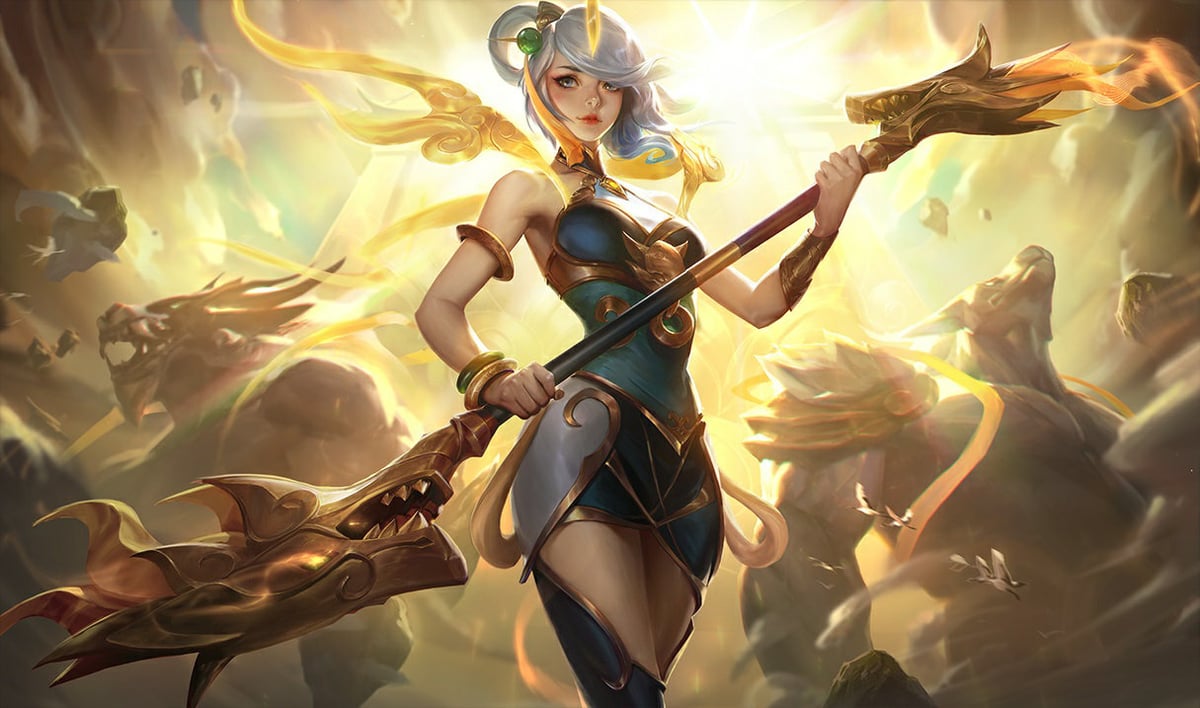
Reading a draft is mostly about absences. Ask these before minions spawn: who walks in first, whose game is longer, and which single player on their team has to die.
League of Legends Guide
Reading Team Comps
Before Minions SpawnMost players look at a finished draft and see ten champions. The useful version is four or five questions, and the answers decide how you should spend the next twenty-five minutes.
Count the frontline
The simplest question first: when a fight starts, who walks in? A team with nobody willing to take the first three seconds of damage can't start a fight (whatever else it has).
If that's them, you can walk at them. If that's you, stop looking for fights and start looking for picks, because the version of the game where five people stand in a line and press buttons is one you lose.
Find the engage, then find who follows it
Engage on its own is a liability. What matters is whether anything happens afterward, and plenty of teams have somebody who can start a fight and nobody who benefits from one starting.
Look for the pair rather than the single champion. One player who can force a fight plus one who wins fights is a plan. Either alone is somebody about to die at the front of a losing team.
Before you commit to any of that, check their disengage. A team that can break up your engage turns your best plan into their best opportunity, and it's the most commonly missed thing in a draft (it doesn't look like power on the loading screen). You can still fight, but the fight has to start somewhere they can't undo (usually by catching one person rather than running at five).
Work out whose game is longer
Every draft has a clock. If they scale harder than you, every minute that passes is a minute you lost, and the fair, patient farming game is the losing one (even when the scoreboard looks fine).
Decide this in the first two minutes and then play like you mean it. Half the games that feel like they slipped away were won for twenty-five minutes and handed over by somebody playing slowly on purpose.
Ask who can take a turret without a fight
Objectives end games, and some teams can chip a turret down from safety while others have to earn it by killing somebody first. That difference decides how the middle of the game feels.
If they can and you can't, you have to catch people. If you can and they can't, you never have to take a fight you don't like.
Identify the person who has to die
Almost every team has exactly one player who converts an advantage into a win, and it isn't always the obvious one. Sometimes it's the marksman, sometimes it's whoever has been unkillable in the side lane for ten minutes.
Say it to yourself before the fight starts. Fights are chaotic and the default is to hit whoever is closest (almost always the wrong answer).
Notice what they can't do
Reading a composition is mostly about absences. No hard crowd control, no way to catch a runner, nothing that handles a fed tank, nobody who can push a lane alone: any one of those is a hole you can build a whole game around.
Gaps are also easier to spot than strengths. Strengths announce themselves, and holes only show up if you go looking.
The short version
Count the frontline, find the engage and its follow-up, decide whose clock is running, and name the one player who has to die. Four answers in the loading screen are worth more than any amount of in-game improvisation.
For the fights themselves, our teamfight champions list covers who wins a 5v5, and our team comps hub has full compositions built around single ideas.



No comments:
Post a Comment
Feel free to comment or leave a message :)